Exotic Material Needle Valve

EF70
  • Precision needle valve designed for high-pressure instrumentation and flow control applications
  • Available in Super Duplex UNS S32750 / F53 for enhanced corrosion resistance in aggressive media
  • Compact and automation-ready design compatible with EFSmatic electric actuators and IoT integration
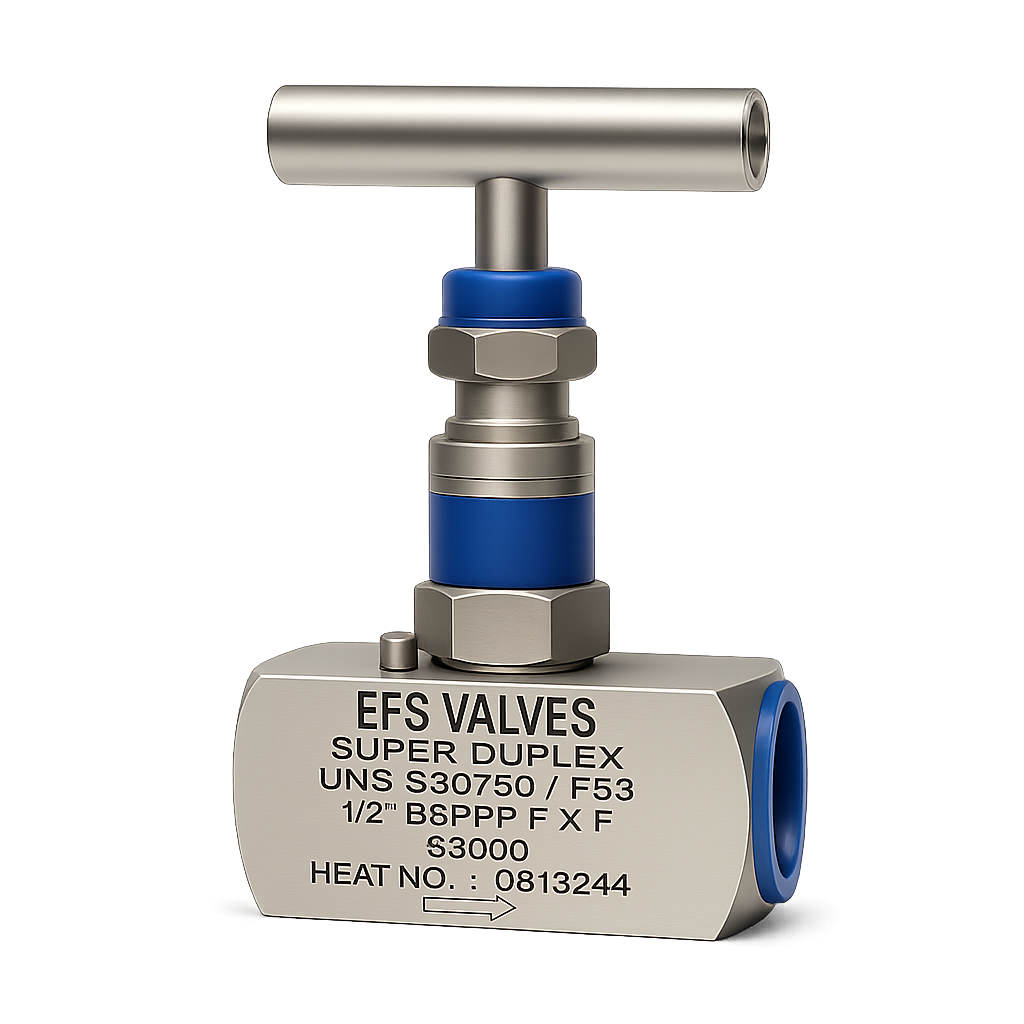
EF70 exotic material needle valve for corrosive service flow control

Applications

Périmètre de service configuré
Chemical Processing
Corrosive Service
Oil & Gas
Petrochemical
Seawater / Desalination
Water Treatment

Key Specifications

NOMINAL SIZES1/4", 3/8", 1/2", 3/4", 1"
PRESSURE RATINGClass 6000 PSI
TEMPERATURE RANGE-30°C to +200°C
END CONNECTIONSNPT / BSP / SW / BW
MATERIALSSuper Duplex UNS S32750 / F53, Stainless Steel 904L, Hastelloy, Titanium
ORIFICE RANGE4.0 to 10.0 mm
CV / KV RANGECv 0.45 to 2.10 / Kv 0.39 to 1.81

Selection & RFQ Assistant

Help us identify the right solution
Demande guidée

Préparez une ligne de demande de prix technique avec les données de service, les conditions de dimensionnement, les accessoires et les documents.

01
Service
02
Procédé
03
Options

FAQs

A high-pressure needle valve is used where controlled flow adjustment or isolation is required in small-bore piping and instrumentation systems. The EF70 is designed for applications requiring pressures up to 6,000 psi, depending on the applicable valve configuration and operating conditions. Typical applications can include instrumentation lines and high-pressure process systems where accurate and progressive valve operation is required.
Yes. Super Duplex stainless steel is widely used in seawater, desalination and other chloride-rich environments because of its high resistance to localized corrosion compared with conventional austenitic stainless steels. For the EF70, Super Duplex can therefore be considered for instrumentation and small-bore applications exposed to demanding seawater or desalination service. Final material selection should always consider the actual fluid, chloride concentration, temperature, pressure and project requirements.
High-pressure desalination systems combine elevated pressure with chloride-rich process conditions, making both pressure capability and material selection important. A Super Duplex EF70 needle valve combines high-pressure capability with the corrosion resistance associated with Super Duplex stainless steel, making it particularly relevant for small-bore and instrumentation duties in desalination applications. The final configuration should be selected according to the actual operating conditions.
PREN, or Pitting Resistance Equivalent Number, is commonly used as an indicator when comparing the resistance of stainless steels to localized pitting corrosion. This can be particularly relevant for instrumentation components exposed to seawater and other chloride-rich environments. Super Duplex grades used for demanding chloride service are commonly associated with PREN values around or above 40, although PREN should not be considered the only material-selection criterion. Actual material chemistry, temperature and service conditions must also be considered.

ABOUT EF70

The EF70 Needle Valve Series is designed for precise flow control and reliable isolation in demanding industrial applications where corrosion resistance and operational reliability are critical. Manufactured for services up to 6000 PSI, the EF70 is especially suitable for instrumentation, desalination, water treatment, chemical processing and offshore environments.

Produced in Super Duplex UNS S32750 / F53, the valve offers excellent resistance against pitting and localized corrosion thanks to its high PREN characteristics, helping extend service life and reduce leakage risks in aggressive media applications.

The EF70 is available in multiple configurations including:

  • Threaded connections
  • Welded versions
  • Other customized arrangements upon request

To support modern plant automation, the valve can also be prepared for integration with our EFSmatic electric actuator system, enabling remote operation, PLC/DCS compatibility and IoT-ready process integration for advanced monitoring and predictive maintenance strategies.

Frequently Asked Questions

A high-pressure needle valve is used where controlled flow adjustment or isolation is required in small-bore piping and instrumentation systems. The EF70 is designed for applications requiring pressures up to 6,000 psi, depending on the applicable valve configuration and operating conditions. Typical applications can include instrumentation lines and high-pressure process systems where accurate and progressive valve operation is required.
Yes. Super Duplex stainless steel is widely used in seawater, desalination and other chloride-rich environments because of its high resistance to localized corrosion compared with conventional austenitic stainless steels. For the EF70, Super Duplex can therefore be considered for instrumentation and small-bore applications exposed to demanding seawater or desalination service. Final material selection should always consider the actual fluid, chloride concentration, temperature, pressure and project requirements.
High-pressure desalination systems combine elevated pressure with chloride-rich process conditions, making both pressure capability and material selection important. A Super Duplex EF70 needle valve combines high-pressure capability with the corrosion resistance associated with Super Duplex stainless steel, making it particularly relevant for small-bore and instrumentation duties in desalination applications. The final configuration should be selected according to the actual operating conditions.
PREN, or Pitting Resistance Equivalent Number, is commonly used as an indicator when comparing the resistance of stainless steels to localized pitting corrosion. This can be particularly relevant for instrumentation components exposed to seawater and other chloride-rich environments. Super Duplex grades used for demanding chloride service are commonly associated with PREN values around or above 40, although PREN should not be considered the only material-selection criterion. Actual material chemistry, temperature and service conditions must also be considered.
Super Duplex should be considered when the expected chloride exposure, temperature or corrosion conditions require greater resistance to localized corrosion than conventional 316L stainless steel can provide. This can be particularly relevant in seawater, desalination and other chloride-rich process environments. The decision should be based on the complete operating conditions and project requirements rather than on material grade alone.
Yes. The EF70 is designed for high-pressure small-bore and instrumentation applications, with configurations available for working pressures up to 6,000 psi. The appropriate valve configuration depends on pressure, temperature, fluid, connection type, material and the required operating function.
Yes. Needle valves are commonly used for the isolation of pressure gauges, transmitters and other process instrumentation, particularly where progressive valve operation is preferred to rapid on-off isolation. The EF70 can be considered for these applications when its pressure capability, material and connection configuration are compatible with the process conditions.
A ball valve is primarily intended for rapid on-off isolation, while a needle valve provides more progressive opening and closing through the movement of its stem. For instrumentation and small-bore applications where controlled adjustment or gradual isolation is required, a needle valve can therefore be more appropriate. The correct valve type depends on the required function, flow conditions and process requirements.
The EF70 can be supplied with different connection types, including: - NPT - BSP - Socket Weld (SW) - Butt Weld (BW) The appropriate connection should be selected according to the piping or instrumentation system and project requirements.
Yes. Different inlet and outlet connection configurations can be considered where required by the installation. Availability depends on the valve size, connection combination, pressure requirements and manufacturing configuration, and should therefore be confirmed during quotation.
Yes. In addition to Super Duplex, the EF70 can be considered in corrosion-resistant materials including AISI 904L, Hastelloy and Titanium, depending on the required configuration and manufacturing feasibility. Material selection should be based on the actual process fluid, concentration where relevant, temperature, pressure and corrosion conditions. Special-alloy requirements should be defined during the RFQ stage.
Yes. The EF70 can be configured with electric actuation where remote or automated operation is required. The actuator and control configuration should be selected according to the required operating function, valve conditions and control requirements of the installation.
Yes. When supplied with the appropriate electric actuator and control configuration, the automated EF70 can be integrated into PLC or DCS-based control systems. The required control signals, feedback and operating philosophy should be defined for the specific application so that the actuator configuration can be selected accordingly.
The main information normally required includes: - Process fluid - Fluid concentration or composition where relevant - Operating and design pressure - Operating and design temperature - Connection size - Inlet and outlet connection type - Material requirements - Required operating function - Manual or automated operation - Applicable project specifications For project applications, inspection, testing and documentation requirements should also be identified during the RFQ stage.
Delivery time depends on the material, size, quantity, configuration and project requirements. Standard configurations may have shorter availability, while special alloys, specific connection arrangements or project requirements can require additional manufacturing time. The applicable delivery time is confirmed with each quotation.
Yes. EFSVALVES can coordinate logistics and international delivery according to the agreed supply conditions and project requirements. Inspection before delivery can also be arranged when it forms part of the agreed scope, including customer or third-party inspection where required. Any specific inspection requirements should preferably be identified at RFQ stage so that they can be evaluated together with the valve supply.
Yes. The EF70 can be supplied within EPC and project-managed environments where defined engineering, quality, inspection, material traceability and documentation requirements apply. Depending on the agreed project scope, documentation may include: - Material certificates - PMI reports where required - Applicable NDT reports - Pressure test records - Inspection documentation - Data sheets and dimensional documentation - Material traceability documentation Project-specific documentation, PMI, NDT or inspection requirements should be identified during the RFQ stage so that their applicability and scope can be evaluated and agreed before order.