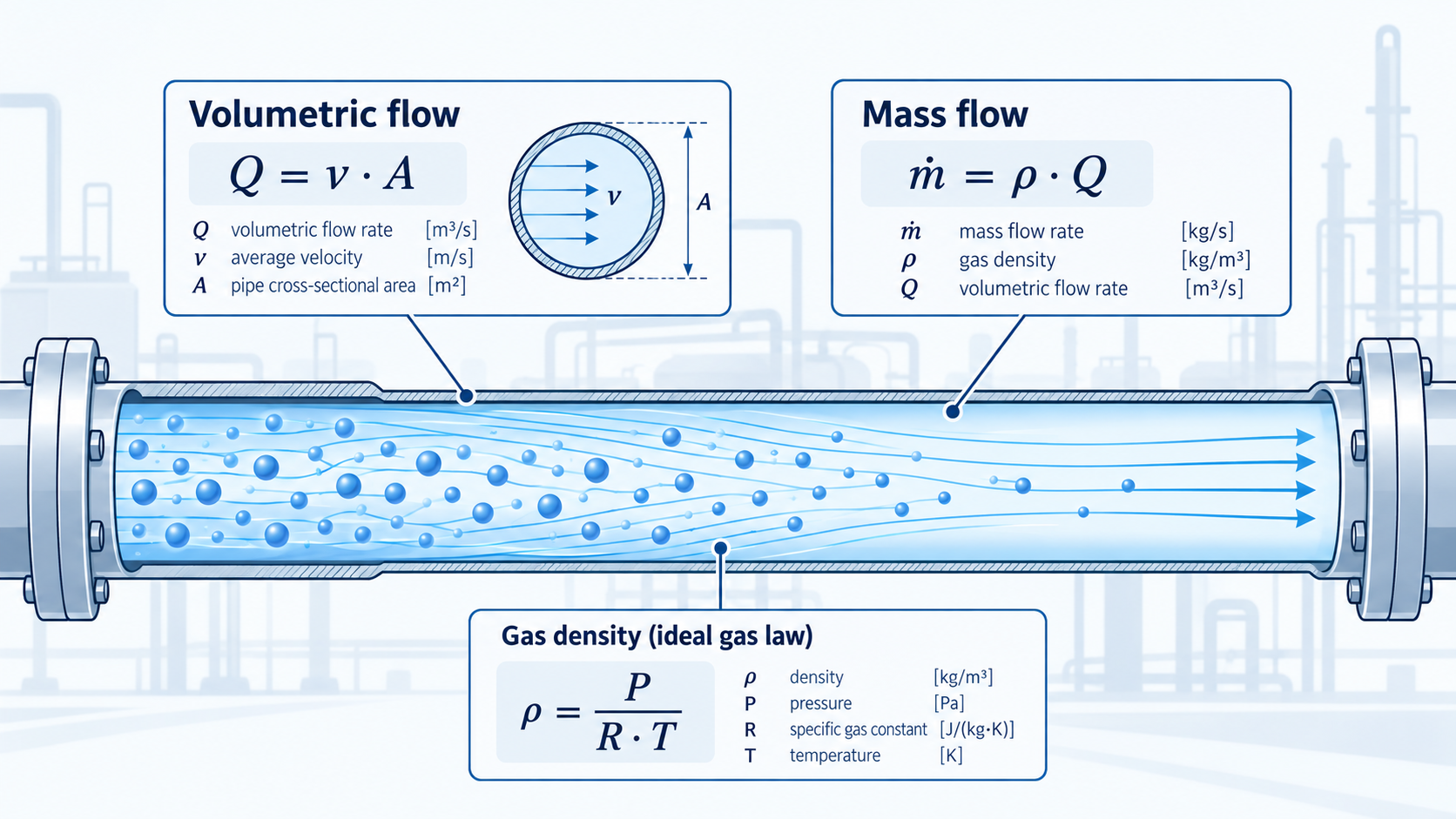
Mass flow and volumetric flow describe the same moving fluid from two different perspectives. One measures how much mass crosses a point per unit time; the other measures how much space that fluid occupies per unit time. The distinction is essential in gas systems because volume changes with pressure and temperature, while mass is conserved.
What is volumetric flow?
Volumetric flow rate, usually written as Q, is the volume of fluid passing through a section of pipe per unit time. Typical units include m³/h, l/min, ft³/min and CFM.
For liquids under ordinary process conditions, density often changes only slightly, so volumetric flow can provide a direct and practical measure. For gases, however, the same amount of gas occupies less volume at higher pressure and more volume at higher temperature. A gas-flow value expressed only in m³/h or CFM is therefore incomplete unless its pressure and temperature basis is clear.
What is mass flow?
Mass flow rate, written as ṁ, is the mass crossing a section per unit time. Common units are kg/h, kg/s, t/h and lb/h. Because mass does not depend on the space occupied by the fluid, mass flow is especially useful for material balances, dosing, consumption measurement and processes where the delivered quantity must remain comparable as gas density changes.
Mass flow does not mean that pressure, temperature or composition can be ignored. These variables still affect fluid properties and the suitability, range and accuracy of the measuring technology. The advantage is that the reported quantity itself is mass rather than an uncorrected volume.
The relationship between mass, volume and density
The fundamental relationship is:
ṁ = ρ × Q
where ṁ is mass flow, ρ is fluid density at the applicable conditions and Q is volumetric flow. The equation explains why a volumetric reading cannot be converted into mass without knowing—or measuring—the density.

For a gas, density depends mainly on absolute pressure, absolute temperature and gas composition. If any of these changes, the mass represented by one actual cubic metre also changes.
Why can the same gas produce different volumetric readings?
Imagine the same mass of gas moving through two sections of a system. At the higher-pressure point it is compressed into a smaller volume. After a pressure reduction it expands and occupies a larger volume. The actual m³/h values can therefore differ even when the mass flow is unchanged.

This is not a measurement contradiction. The meters are describing volume at different local conditions. Meaningful comparison requires the same gas composition and the same pressure-and-temperature basis, or conversion to a shared reference condition.
Actual, normal and standard volumetric flow
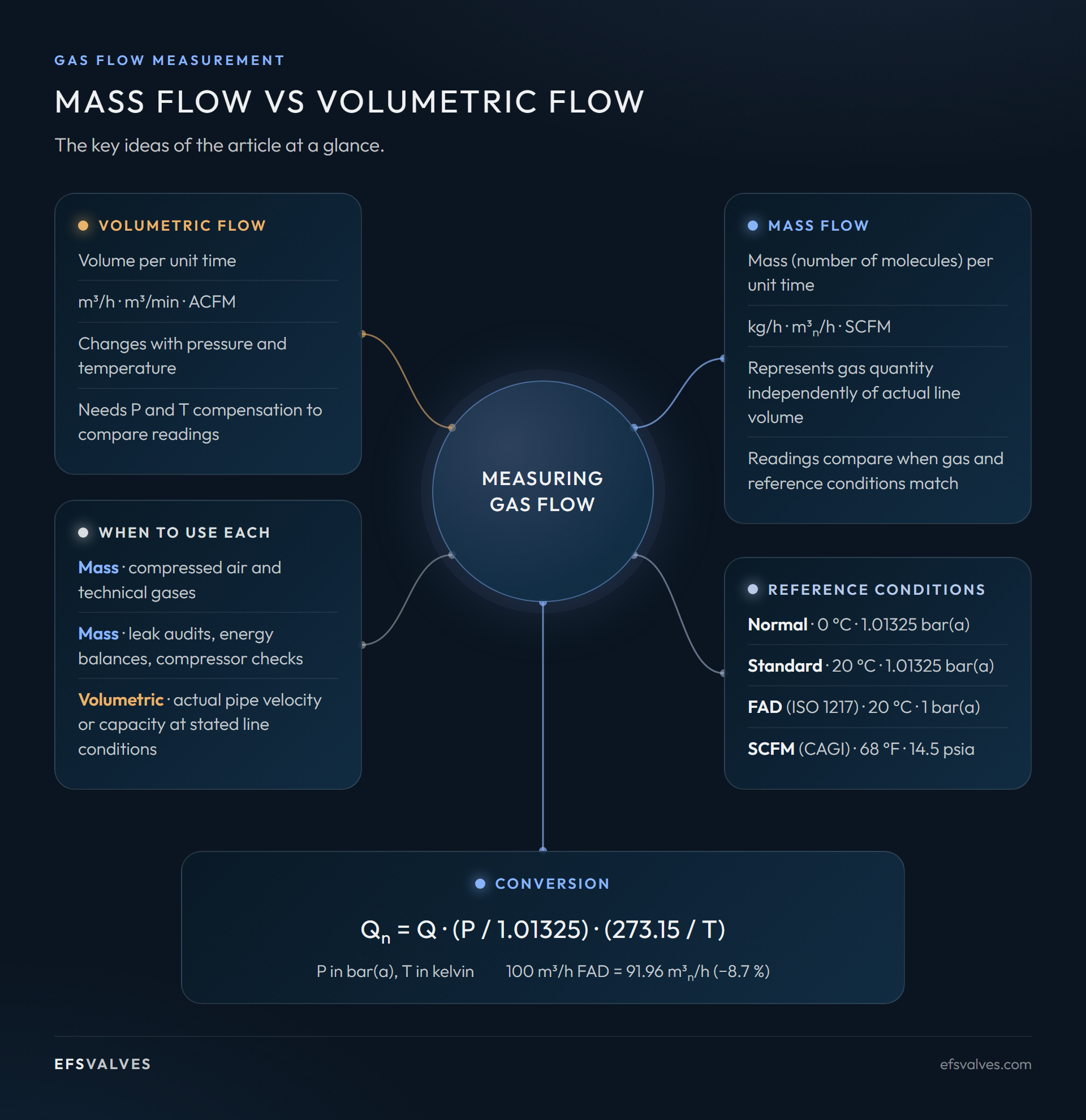
Actual volumetric flow refers to the volume at the meter’s real operating pressure and temperature. It is useful for pipe velocity, local pressure drop and capacity checks.
Normal or standard volumetric flow is a mass-related quantity expressed as the volume that the gas would occupy at a specified reference pressure and temperature. Units such as Nm³/h, Sm³/h, SCFM and FAD are only unambiguous when the exact reference condition and gas basis are stated.

Common conventions include Normal at 0 °C and 1.01325 bar(a), Standard at 20 °C and 1.01325 bar(a), free air delivery at 20 °C and 1.000 bar(a), and the CAGI compressed-air reference at 68 °F and 14.5 psia. Project specifications may use other definitions, so the label alone should never replace the actual temperature and absolute pressure.
How to convert a gas-flow value
For a dry gas using an ideal-gas approximation, an actual volumetric flow can be converted to a reference volume with:
Qref = Qactual × (Pactual / Pref) × (Tref / Tactual)
Pressure must be absolute and temperature must be in kelvin or another absolute scale. For higher accuracy or non-ideal conditions, the compressibility-factor ratio must also be included:
Qref = Qactual × (Pactual / Pref) × (Tref / Tactual) × (Zref / Zactual)
As a simple reference-to-reference example, 100 m³/h stated as FAD at 20 °C and 1.000 bar(a) corresponds to approximately 91.96 Nm³/h at 0 °C and 1.01325 bar(a), assuming the same dry ideal gas. This conversion changes the numerical volume, not the amount of gas.
Which flow quantity should you use?
The correct choice starts with the engineering purpose rather than the preferred unit:
- Use mass flow for material balances, dosing, consumption or transfer when the quantity of matter is the key variable.
- Use actual volumetric flow for line velocity, local capacity and pressure-drop work at known operating conditions.
- Use standard or normal volumetric flow when gas quantities must be compared on one declared reference basis.
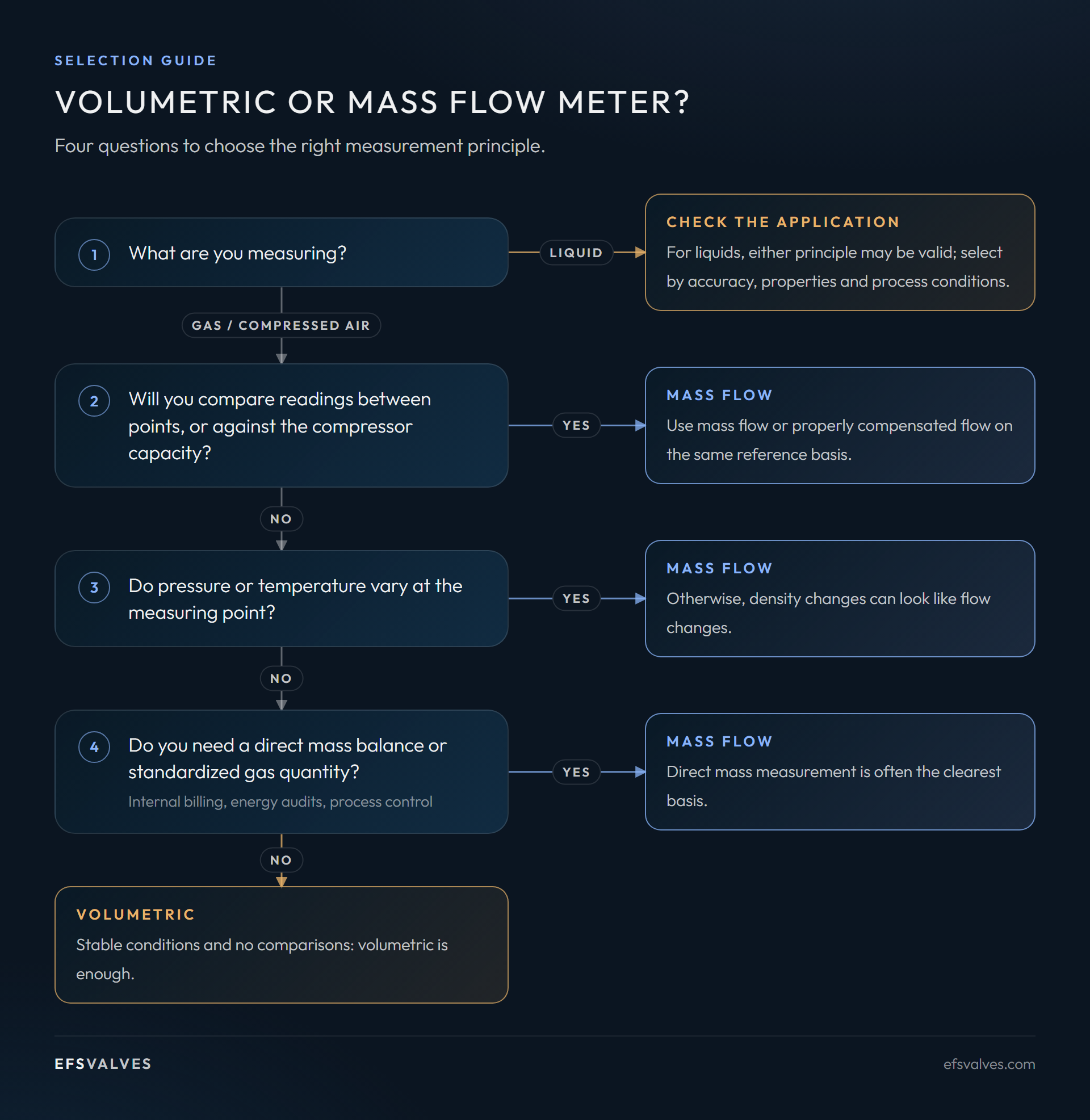
Instrument technology is a separate decision. Fluid phase and composition, minimum and maximum flow, pressure, temperature, turndown, accuracy, pressure loss, installation profile and maintenance requirements must all be reviewed. Both mass- and volume-based measurement principles can be valid for liquids and gases when correctly selected.
What to state on a datasheet or RFQ
- Gas or liquid composition and phase.
- Whether the required value is mass flow, actual volume or reference volume.
- Minimum, normal and maximum flow.
- Operating and design pressure and temperature.
- The exact reference temperature and absolute pressure for Nm³/h, Sm³/h, SCFM or FAD.
- Required accuracy, turndown, connection and installation constraints.
When the quantity, units and reference conditions are all stated explicitly, flow values become comparable and the risk of selecting or sizing equipment from unlike data is greatly reduced.