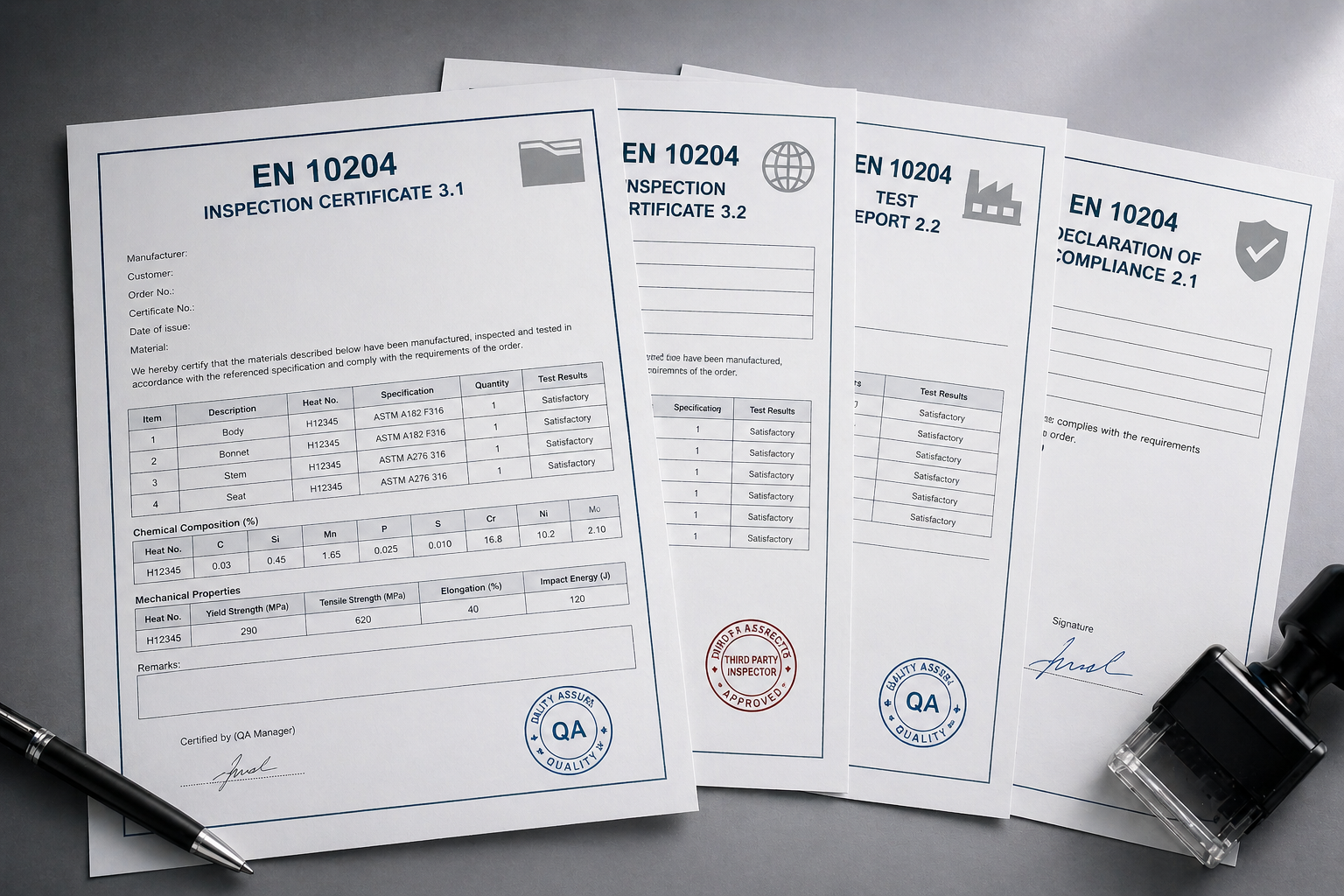
Imagine everything is ready to ship your valve, but the client insists: «We need a 3.1 certificate according to EN 10204.»
And here come the questions. What is that? Who issues it? What if I only have a 2.2? This guide explains one of the most requested, and often misunderstood, documentation requirements in the valve world.
What Is the EN 10204 Standard?
EN 10204 is a European standard that defines inspection and certification documents for metallic products. While it was originally created for steel and forged parts, it is widely used today for valves, pipes, flanges and industrial fittings.
It is especially relevant in regulated sectors such as petrochemicals, power generation, food and beverage, pharmaceuticals, offshore and other industrial projects where traceability and material compliance matter.
Types of EN 10204 Certificates
The four most common document types are 2.1, 2.2, 3.1 and 3.2. The key difference is whether the document includes test results, whether those results belong to the delivered batch and who validates them.
2.1 – Declaration of Compliance
- The manufacturer declares that the product complies with the purchase order.
- No test results are attached.
- No product-specific traceability is provided.
- Typically used for standard or non-critical parts.
2.2 – Non-Specific Test Report
- The manufacturer provides test results, but not necessarily from the actual delivered batch.
- It usually includes general production data.
- It does not provide traceability to a specific product or heat.
3.1 – Specific Inspection Certificate
- The manufacturer declares compliance and provides actual test results from the delivered batch.
- The material origin and properties are traceable and verifiable.
- It is signed by an authorized Quality Department representative independent from production.
- This is the most commonly requested certificate for industrial valves.
3.2 – Dual Validation Certificate
- It includes the same batch-specific information as a 3.1 certificate.
- It also includes verification by an external inspector, appointed by the client or an independent third-party body.
- It is commonly required for high-criticality projects, public entities, nuclear, offshore or demanding EPC specifications.
Quick Comparison Table
| Type | Includes tests? | Batch-specific? | Traceable? | Signed by |
|---|---|---|---|---|
| 2.1 | No | No | No | Manufacturer |
| 2.2 | Yes, generic | No | No | Manufacturer |
| 3.1 | Yes | Yes | Yes | QA/QC department, independent from production |
| 3.2 | Yes | Yes | Yes | QA plus independent inspector |
What Does This Mean for Your Valves?
For valves, EN 10204 certificates help confirm that pressure-retaining parts and relevant components have suitable, traceable and compliant material origins.
- The body, bonnet and pressure-retaining parts can be linked to traceable materials.
- Mechanical or chemical tests were performed and documented when required.
- In some cases, pressure tests such as hydrostatic or leak tests are also included.
When a client asks for a valve with a 3.1 certificate, that request must be supported by batch-specific, traceable documentation, not only a generic statement of compliance.
Are There Equivalents in Other Standards?
There are related documentation practices in other standards, although they are not always direct one-to-one equivalents.
- ASTM A370, used in the United States, focuses on mechanical testing.
- ASME Section II / III is used in pressure vessel and nuclear fields.
- MTC, or Mill Test Certificate, is commonly used in API and ISO-based systems and is often functionally close to a 3.1 when it is batch-specific and traceable.
Ultimately, what matters is who signs the certificate, what data it includes and whether it matches the goods actually delivered.
Common Pitfalls
- Assuming a 2.2 certificate is the same as a 3.1. It is not.
- Forgetting to request the certificate during ordering. It may be impossible or very costly to retrieve later.
- Confusing CE conformity with EN 10204 3.1. They are completely different requirements.
- Requesting a 3.2 certificate without client or third-party inspection presence. It cannot simply be fabricated after the fact.
What Should You Ask For?
| Application | Typical certificate level | Reason |
|---|---|---|
| General services, water, HVAC | 2.1 or 2.2 may be enough | Lower criticality and standard documentation requirements |
| Industrial processes, chemicals, steam, high pressure | 3.1 recommended | Batch traceability and material verification are usually expected |
| Nuclear, offshore, defense, EPC projects | 3.2 often mandatory | Independent inspection and dual validation may be required |
Tip: under PED/CE-related requirements, a 3.1 certificate is often the minimum expected for pressure-bearing components, depending on the project and equipment category.
Summary
If you want to guarantee quality, traceability and regulatory compliance, knowing which certificate to request is as important as choosing the right valve.
At EFSVALVES, we operate under a certified ISO quality system and are familiar with issuing EN 10204 certificates, including documentation packages that require third-party inspections for 3.2 certification.
Our Quality and Projects team works closely with clients to define the most suitable test plan based on valve type, applicable standards and project criticality.
For pressure safety valves (PSVs), certificates can include information such as set pressure, hydrostatic test and, for API-design valves, leak test results according to API 527 when specified by the client.
Still unsure about which certificate you need? Reach out to EFSVALVES and we will help define the right documentation path for your system.