In desalination, seawater, brine and high-pressure skids, not every critical component is large. Sometimes a small needle valve is what allows pressure adjustment, bypass control, auxiliary line stabilization or regulation of a specific part of the process.
If the adjustment is occasional, accessible and stable, a manual valve may be the best solution: simple, robust and reliable. But when the system evolves, the way it is operated also changes.
If the valve is installed in a hard-to-access location, if it needs to be adjusted frequently, if it handles seawater or brine, or if the complete system already works with PLC, SCADA, sensors, alarms and remote operation, manual regulation may no longer be enough.
At that point, automation is no longer an aesthetic option. It becomes an operational and integration decision.
Material Comes First
Before discussing actuators, the service conditions must be considered. In applications involving seawater, brine or chlorides, material selection is not a minor detail. A standard valve may be suitable for many industrial processes, but in desalination or marine environments, corrosion resistance becomes a central part of the specification.
For this type of application, a needle valve should be evaluated according to three main variables: material compatibility, working pressure and actual function within the system.
| Specification point | Why it matters | Typical question |
|---|---|---|
| Material compatibility | Seawater, brine and chlorides can accelerate corrosion if the material is not suitable. | Is super duplex, duplex or another alloy required? |
| Working pressure | Needle valves are often selected for fine regulation under demanding pressure conditions. | What is the maximum working pressure and differential pressure? |
| Function in the system | The same valve can behave differently depending on whether it is used for bypass, adjustment, isolation assistance or auxiliary regulation. | What role does the valve play in the P&ID? |
When pressure, corrosion and fine adjustment meet, the starting point must be a needle valve suitable for the service. In many cases, this means working with super duplex. Automation comes afterwards, when the operation justifies it.
Manual EF70 or Automated EF70-E
Not everything needs to be automated. A manual EF70 in super duplex may be the most logical solution when the adjustment is occasional, access is convenient and the valve does not need to be integrated into a control sequence. It is a simple, robust and direct solution.
The automated version starts to make sense when manual operation becomes a limitation.
| Manual EF70 may be enough when… | Automated EF70-E becomes relevant when… |
|---|---|
| Adjustment is occasional. | The valve needs repeated or frequent adjustment. |
| The valve is easy to access. | The valve is installed in an inconvenient or remote location. |
| Operator variation is not a critical issue. | Different operators may leave different positions. |
| The valve is not part of a control sequence. | The system already works with PLC or SCADA. |
| Simple mechanical robustness is the priority. | Remote operation, repeatability and traceability are required. |
| Manual intervention is acceptable. | Manual intervention should be reduced. |
In these cases, automation is not a trend. It is a way of bringing the valve into the logic of the system.
EF70-E: The Automated Evolution
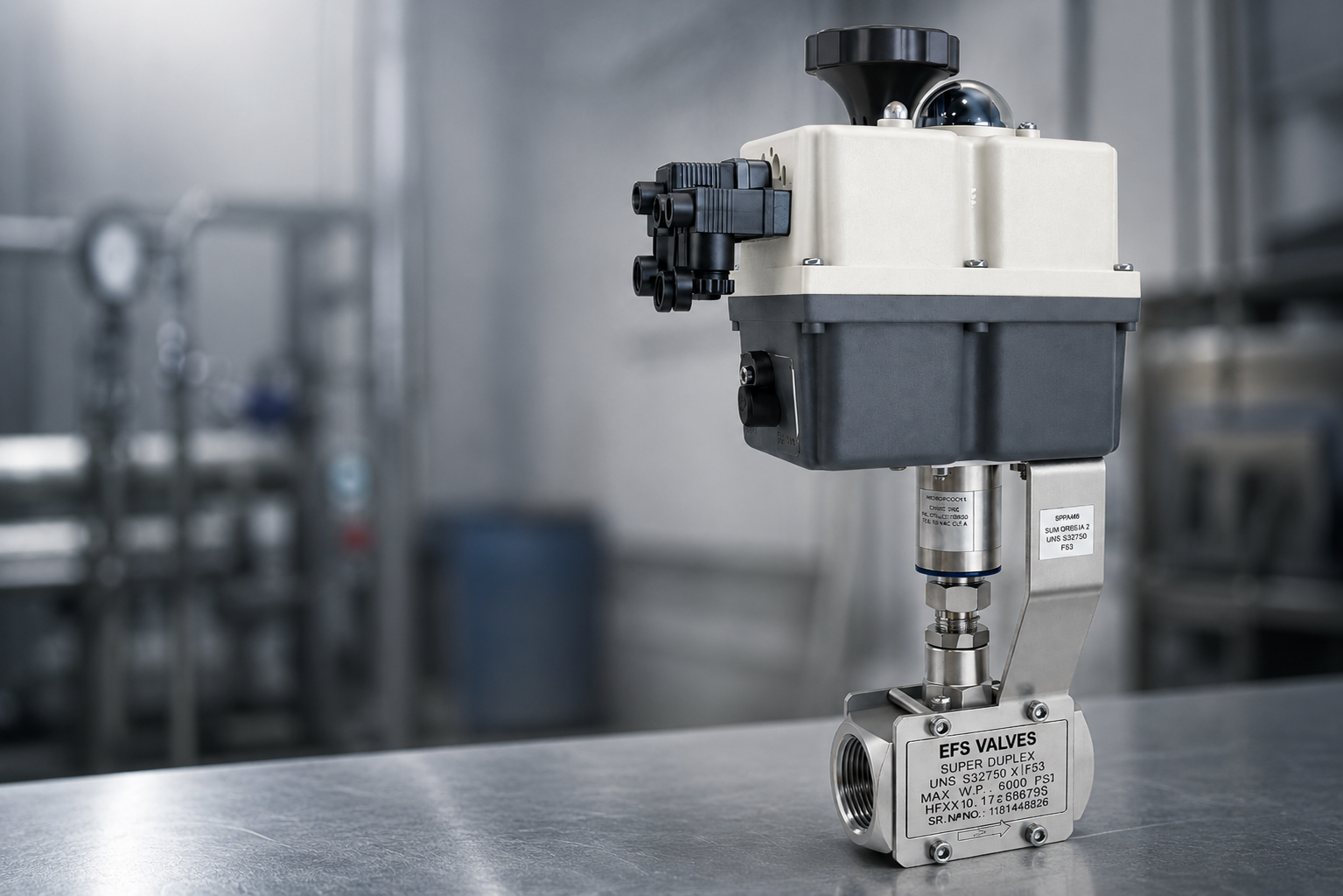
The EF70-E is the automated evolution of the EF70 needle valve by EFSVALVES. The base remains the same: a high-pressure needle valve, available in super duplex and designed for demanding services. What changes is the operation.
By integrating an electric multi-turn actuator, the valve can move from manual regulation to remote, repeatable operation, ready for integration into control systems.
Depending on the selected configuration, the actuator allows On-Off operation or positioning by analogue signal, such as 4-20 mA or 0-10 V. It also includes electronic torque limitation, a particularly relevant function in needle valves, where manual over-tightening may affect the seat or the repeatability of operation.
What Changes in Practice
Automation can add value when the valve is part of a wider assembly: a skid, an auxiliary line, a compact unit, a test bench or an installation where signals, alarms, sensors and operating logic already exist.
| Operational change | Practical value |
|---|---|
| Remote operation | The valve can be operated without local manual intervention. |
| PLC/SCADA integration | The regulation point can be included in the wider control architecture. |
| Analogue positioning | Configurations such as 4-20 mA or 0-10 V can support repeatable adjustment. |
| Electronic torque limitation | Helps reduce the risk of over-tightening. |
| Improved repeatability | Less dependence on operator judgement. |
| Integrated documentation | Clearer consistency between valve, actuator, P&ID and technical dossier. |
It is not only about opening or closing a valve. It is about integrating a regulation point into a control architecture that is becoming increasingly common in industry.
Documentation, Quality and Traceability
In demanding applications, the valve is not only a mechanical component. It is also part of a technical file, a project review and, in many cases, a quality dossier.
For this reason, at EFSVALVES, supply is not understood only as a catalogue reference. Material selection, scope definition, traceability, testing and documentation are part of the value of the solution.
| Documentation item | When it may be relevant |
|---|---|
| Assembly data sheet | For technical review and project approval. |
| EN 10204 3.1 material certificate | When material traceability is required. |
| Test certificates | For quality control and acceptance documentation. |
| Installation, operation and maintenance manual | For site teams and maintenance procedures. |
| Actuator documentation | When electrical integration or control signals are part of the scope. |
| PMI, Positive Material Identification | When required by project specification. |
| NDT, non-destructive testing | When required by inspection or project standards. |
| Hydrostatic and seat test reports | For pressure integrity and sealing verification. |
| P&ID configuration review | To confirm the valve function and automation logic. |
This is especially important in international applications, where valve selection must be defendable not only in terms of price or availability, but also in terms of material, pressure, function, documentation, inspection and engineering criteria.
EFSVALVES works with an approach focused on quality, projects and demanding industrial applications. Automation, when incorporated, must follow the same logic: it is not added as a commercial accessory, but as part of a technically coherent solution.
What It Is Not
An automated needle valve does not automatically replace a conventional control valve. Nor is it an emergency shutdown valve or a universal solution for every critical loop.
The EF70-E must be specified according to the real service:
- fluid,
- pressure and differential pressure,
- DN,
- temperature,
- material and seat,
- control signal,
- operating frequency,
- function within the P&ID.
If automation does not add real value, the manual EF70 in super duplex may still be the best option. In demanding services, a good specification does not mean choosing the most complex solution, but the most appropriate one.
Super Duplex Needle Valves: Manual or Automated
At EFSVALVES, we develop high-pressure needle valves in special materials, including super duplex, for desalination, seawater, brine and corrosive services.
When the application requires simplicity, the manual EF70 may be enough. When the system requires remote operation, PLC/SCADA integration, reduced manual intervention or improved repeatability, the automated EF70-E may be the next step.
Do You Have a Manual Regulation Point in Seawater, Brine or High Pressure?
Tell us the fluid, pressure, DN, required material and function of the valve within the system. We help you assess which option fits better: manual EF70, automated EF70-E or a specific configuration for your application.