This case study has been anonymised. Customer information and project-specific data have been omitted or generalised. Selected design, control and integration details are intentionally not disclosed to protect proprietary engineering and know-how.
A petrochemical plant needed to replace a pressure safety system that had been operating since the early 1970s. The original concept remained valid, but ageing analogue controls, future component availability and increasing maintenance requirements made a modern replacement necessary.
The requirement was not simply another pressure safety valve. EFSVALVES had to preserve the proven operating philosophy while introducing current instrumentation, smart electric actuation, high-temperature materials and a maintainable architecture for long-term service.
Project Background
The existing equipment combined a Pressure Safety Valve (PSV) with electrically assisted operation and analogue control. After several decades of reliable service, its operating principle was still useful, but reproducing obsolete technology would have carried long-term risks for maintenance and spare-part availability.
The project therefore became a brownfield modernisation exercise: retain the required protection philosophy, replace ageing control technology and create a system that could remain serviceable over an extended operating life.
| Project requirement | Engineering relevance |
|---|---|
| 190 barg operating condition | The valve platform, pressure boundary and integrated assembly had to be assessed for demanding petrochemical service. |
| Temperature up to 500 °C | Material selection and critical components required specific high-temperature consideration. |
| Controlled pressure-based actuation | The valve had to respond to a defined process condition through the plant control architecture. |
| Independent mechanical protection | The spring-loaded PSV function had to remain available independently of the digital control path. |
| Long-term maintainability | Wear parts, control components, documentation, training and future support had to be considered from the beginning. |
Why a Catalogue PSV Was Not Enough
Pressure and temperature were only part of the challenge. The replacement also had to interact with the plant control system while retaining an independent mechanical response if the controlled opening did not occur or process pressure continued to rise.
That requirement could not be solved by selecting a standard high-temperature PSV and simply adding an electric actuator. Valve behaviour, actuator integration, pressure instrumentation, hazardous-area requirements, materials, control functionality and mechanical protection had to be reviewed as one engineered system.
EFSVALVES developed a tailor-made solution from proven products and technologies already present in its portfolio:
Pressure instrumentation + upgraded high-temperature PSV + Smart ATEX actuation + independent mechanical protection + manual override
The EFSVALVES Smart Safety Valve Architecture
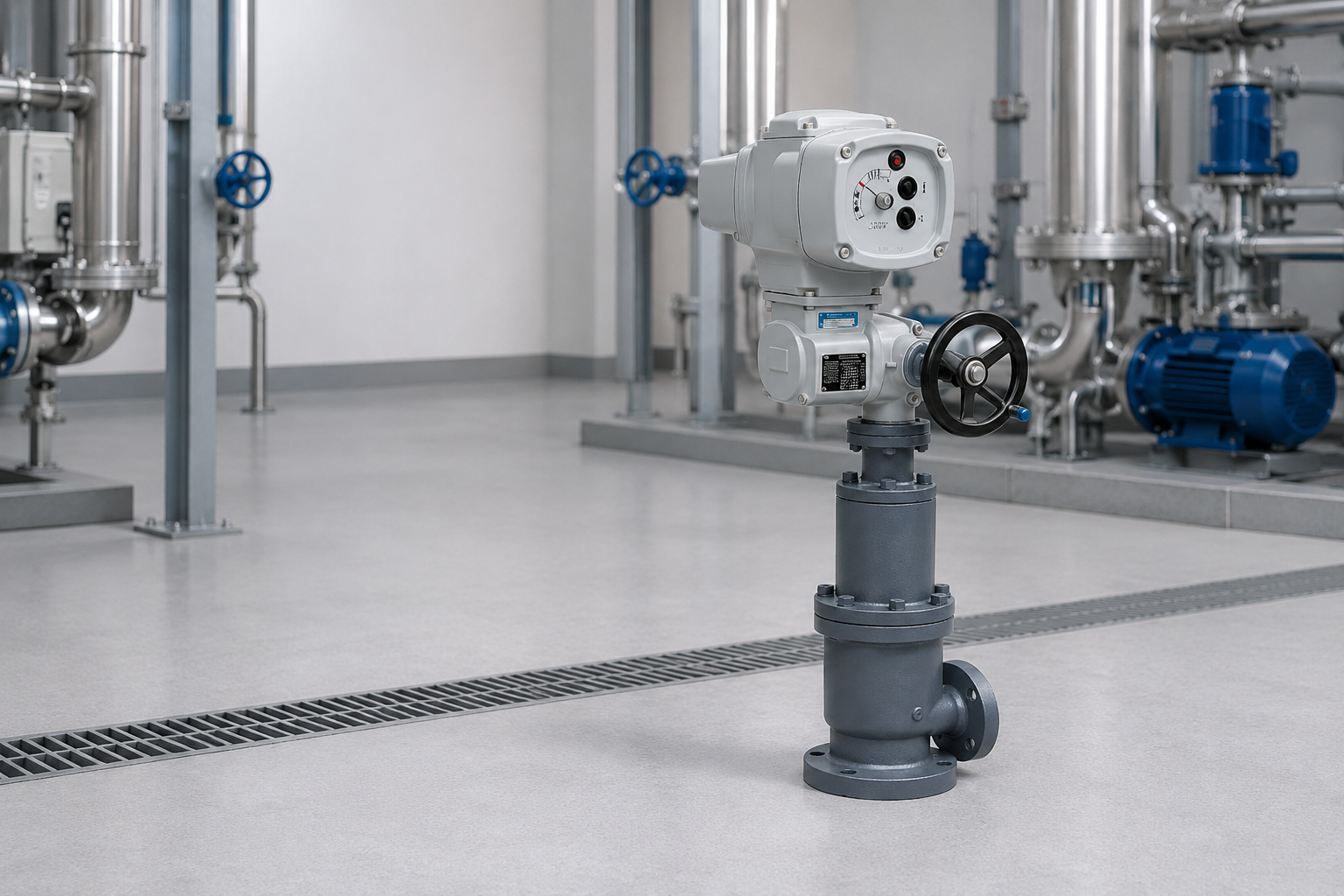
The solution was developed around the EF1415 Pressure Safety Valve platform, based on API 526 design principles and ASME Section VIII requirements. For this project, the PSV platform was adapted for severe high-temperature service and integrated with pressure instrumentation and an intelligent electric actuator suitable for the classified environment.
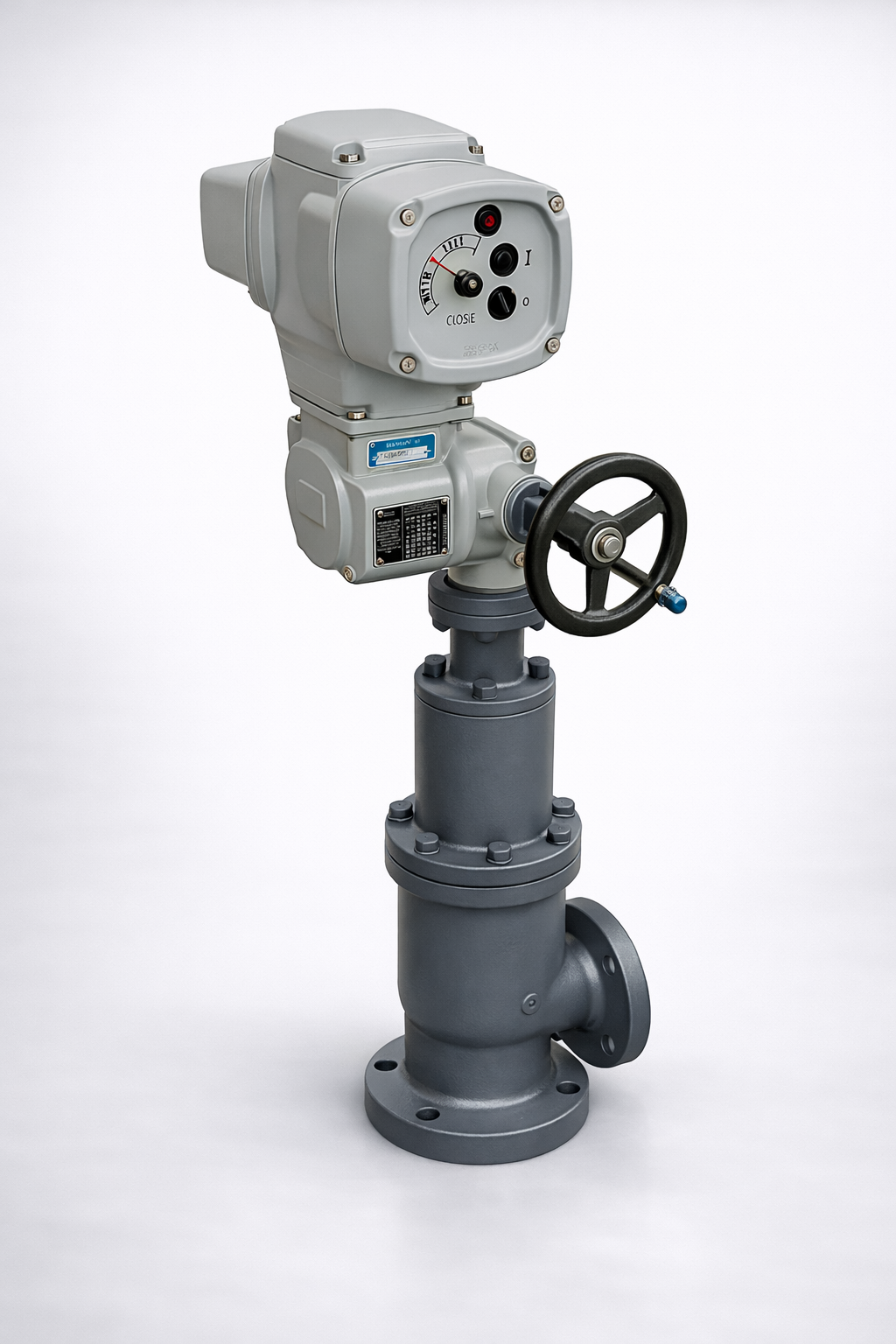
The result was not an off-the-shelf configuration. It was an engineered Smart Safety Valve in which digital control, conventional spring-loaded protection and manual operation perform complementary functions within the same architecture.
Digital control
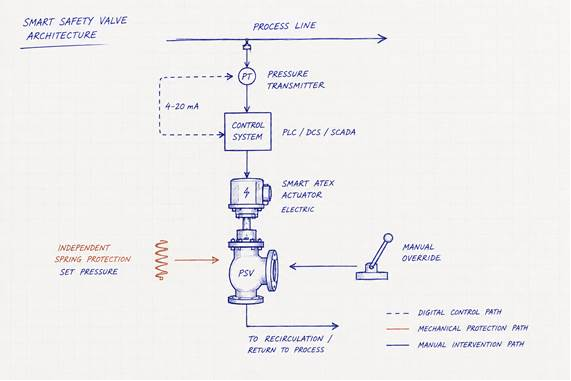
Process pressure is monitored by a pressure transmitter and processed through the plant control system. When the defined operating condition is reached, the control system commands the Smart ATEX electric actuator to operate the PSV.
Independent mechanical protection
The spring-loaded PSV retains an independent mechanical protection function. If controlled opening does not occur, or if process pressure continues to rise, the spring-loaded mechanism remains available to operate at its defined mechanical set pressure.
Manual override
A manual override provides an additional means of direct valve operation when intervention is required.
Controlled Actuation Without Losing Mechanical Independence
The separation between the controlled actuation path and the independent protection path was one of the fundamental engineering principles of the project.
| Functional path | Sequence |
|---|---|
| Digital control | Process pressure → pressure transmitter → control system → Smart ATEX actuator → controlled valve opening |
| Mechanical protection | Process pressure → spring-loaded PSV → mechanical overpressure protection |
| Manual intervention | Local manual override → direct valve operation when required |
The PSV discharge returns to the process through the corresponding recirculation line. The objective was not to turn the PSV into a conventional control valve, nor to replace mechanical protection with electronics. It was to combine controlled smart actuation with independent mechanical protection within a purpose-engineered safety valve architecture.
High-Temperature PSV Engineering at 500 °C
Smart automation was only one part of the solution. The PSV itself had to operate under severe petrochemical conditions at up to 190 barg and 500 °C.
The EF1415 platform was upgraded using high-temperature alloy steel together with selected special and exotic materials in critical components. Material selection considered the combined effects of:
- high temperature and pressure;
- mechanical reliability under severe-service conditions;
- expected operating life;
- future inspection and maintenance requirements.
Detailed material grades and internal design specifications remain project-specific and are intentionally not disclosed.
Lifecycle Engineering and Future Digital Integration
A system that had operated reliably for several decades should not be replaced by a modern solution designed only around today’s electronics. Long-term maintainability was therefore considered from the beginning.
The project reviewed future availability and replacement of control and actuation components together with wear parts, spare parts, maintenance documentation, service requirements and training. The objective was not simply to commission a new Smart Safety Valve, but to provide a system designed to remain serviceable throughout an extended operating life.
The selected Smart ATEX actuator also provides instrumentation and status signals, including 4–20 mA feedback capability, that can be made available to PLC, DCS or SCADA environments. This establishes a basis for future remote monitoring and digital asset management without making independent mechanical protection dependent on digital connectivity.
Testing and Validation
The complete Smart Safety Valve was considered as an integrated system rather than as separate valve, actuator and instrumentation components. Functional validation reviewed the interaction between digital operation, independent mechanical protection and manual intervention.
The client participated during key project stages, including inspection and final assembly. This allowed the completed configuration to be reviewed against both the operating philosophy of the original installation and the future requirements of the plant.
Project Result
A reliable but technologically obsolete pressure safety system was replaced with a modern architecture combining:
- pressure-based instrumentation;
- EF1415 high-temperature PSV technology;
- Smart ATEX electric actuation;
- controlled pressure-based opening;
- independent spring-loaded mechanical protection;
- manual override;
- instrumentation and monitoring capability;
- high-temperature alloy and selected special materials;
- long-term maintenance and spare-parts planning.
The project demonstrates how an ageing petrochemical pressure safety system can be modernised without abandoning the mechanical protection principle that made the original concept reliable.
Not every industrial requirement can be solved from a catalogue. EFSVALVES develops tailor-made configurations from proven valve platforms, adapting materials, instrumentation, automation and protection philosophy to the requirements of each application.
Frequently Asked Questions
Can a spring-loaded PSV be combined with electric ATEX actuation?
Yes, in specifically engineered applications. The PSV, actuator, control requirements and mechanical protection philosophy must be assessed as an integrated system.
Can an automated PSV retain independent mechanical overpressure protection?
Yes. In this application, controlled electric actuation and spring-loaded mechanical protection perform separate functions, allowing the mechanical protection path to remain independent of the digital control path.
Can a PSV operate at 500 °C in petrochemical service?
High-temperature PSV applications require suitable valve design, material selection and engineering assessment for the pressure, temperature, fluid and applicable project requirements. This application required operation at temperatures up to 500 °C.
Does controlled pressure-based opening make the PSV a control valve?
No. An actuated PSV can provide controlled opening from a process pressure signal in a specifically engineered application, but it is not equivalent to a conventional modulating control valve. Control and protection functions must be assessed individually.
Can an obsolete safety valve system be revamped?
Depending on the application, an existing pressure safety philosophy can be reviewed and modernised with current PSV, instrumentation and automation technology. The objective is to preserve the required operating philosophy while improving materials, maintainability, instrumentation and actuation.
Related Engineering
EF1415 Pressure Safety Valve
The Smart Safety Valve developed for this project was based on the proven EF1415 platform, adapted to the specific temperature, materials and automation requirements of the application. Explore the EF1415 Pressure Safety Valve →
Valve Actuation Services
Smart and automated PSV applications require more than actuator selection. Valve behaviour, instrumentation, hazardous-area requirements, mechanical integration, control functionality and maintainability must be considered as part of the complete system. Explore Valve Actuation Services →
High-temperature service, special materials, smart actuation, obsolete equipment replacement and unusual operating requirements may require a tailor-made solution. Discuss your application with our engineering team →