PNEUMATIC QUARTER-TURN ACTUATOR

EFPA90
  • Double-acting or spring-return quarter-turn pneumatic actuation
  • 2 to 8 bar air supply with engineered torque and spring selection
  • ISO 5211 / DIN 3337 mounting and NAMUR accessory integration
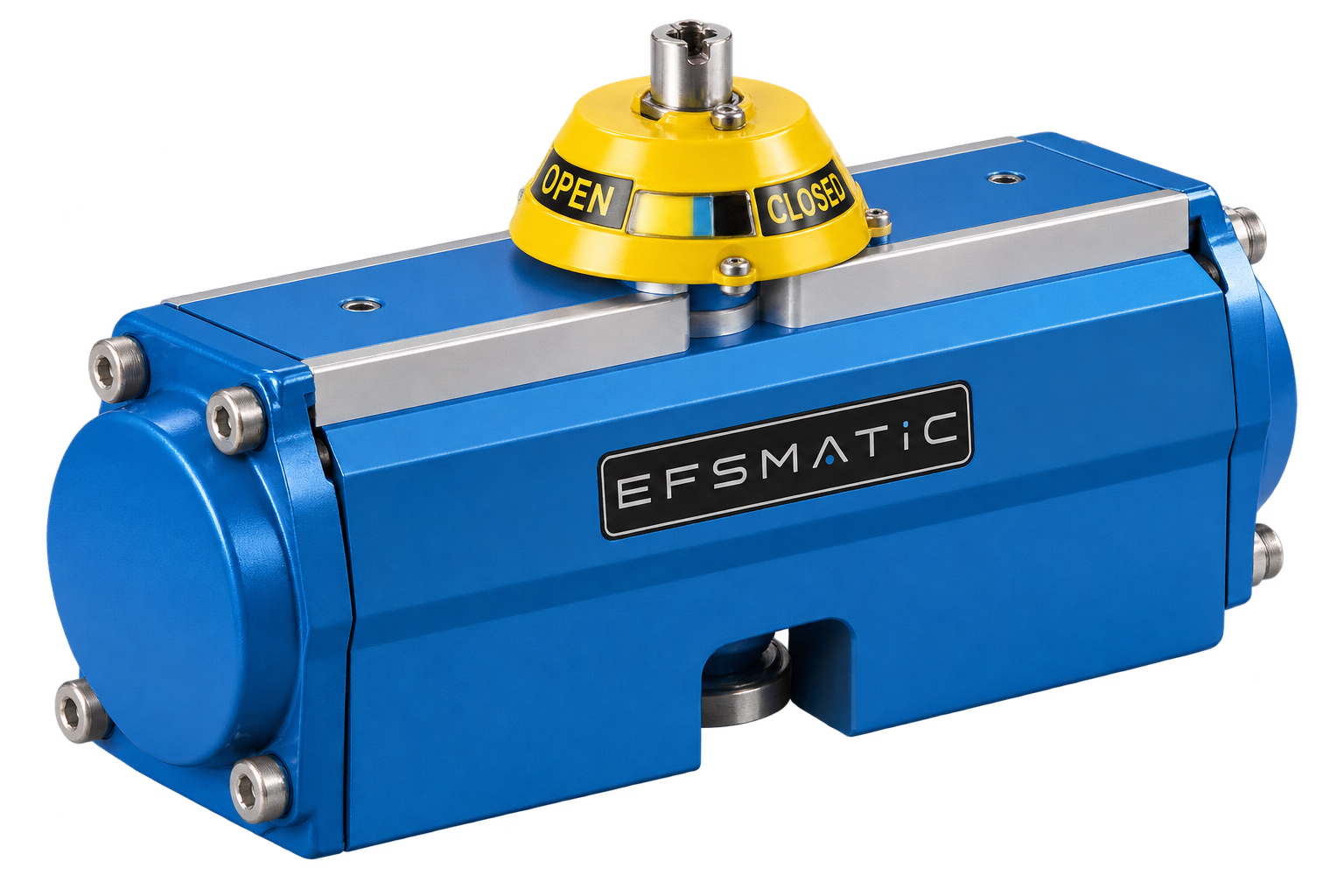
EFPA90 EFSMATIC blue pneumatic quarter-turn actuator with open and closed position indicator

Applications

Configured Service Scope
Chemical Processing
Food & Beverage
Liquid Service
Pharmaceutical
Seawater / Desalination
Water
Water Treatment

Key Specifications

ACTUATIONDouble acting or spring return
OUTPUT TORQUEEngineered selection up to 9,139 Nm, depending on air pressure and configuration
AIR SUPPLY2 to 8 bar; dry or lubricated air and non-corrosive gases
ROTATIONNominal 90 degrees with +/-5-degree travel adjustment
TEMPERATURE RANGE-20 to +80 deg C
MOUNTINGISO 5211 / DIN 3337 with NAMUR accessory interface and G1/4 air connection

Selection & RFQ Assistant

Help us identify the right solution
Configure a complete assembly

Start by configuring your valve

Select the valve and enter its process conditions first. If actuation is required, the RFQ will continue to the compatible actuator and retain the valve data automatically.

Choose a valve

Use actuator-only configuration for an existing or third-party valve.

FAQs

EFPA90 is intended for ball valves, butterfly valves, plug valves and other industrial valves requiring quarter-turn rotary movement. Final selection depends on valve torque, air pressure, safety factor, mounting interface, operating frequency and service conditions.
A double-acting actuator uses air pressure to drive both opening and closing movements. A spring-return actuator uses air in one direction and stored spring energy in the other, allowing a defined fail-open or fail-closed position if air supply is lost.
EFSVALVES reviews the valve operating and breakaway torque, available air pressure, actuator action, required fail position, service conditions and mounting interface. An appropriate engineering margin is then applied before selecting the actuator size and, where applicable, the spring arrangement.
The standard operating range is 2 to 8 bar using dry or lubricated air or another compatible non-corrosive gas. Available pressure at the actuator under operating conditions should be stated in the RFQ.

ABOUT EFPA90

The EFPA90 pneumatic quarter-turn actuator provides engineered automation for industrial ball valves, butterfly valves, plug valves and other rotary valves operating through a nominal 90-degree movement. Its compact dual-piston rack-and-pinion construction is available in double-acting and spring-return configurations for standard On/Off duties, modulating service and defined fail-open or fail-closed safety requirements.

The aluminium body incorporates internal and external corrosion protection, low-friction piston guidance, stainless-steel fasteners and an anti-blowout shaft arrangement. Standardised ISO 5211 and DIN 3337 mounting interfaces and NAMUR accessory provisions facilitate the integration of solenoid valves, limit-switch boxes, positioners and air preparation equipment.

The range operates with dry or lubricated air and non-corrosive gases at supply pressures from 2 to 8 bar. Standard operating temperature is -20 to +80 deg C, with a nominal 90-degree rotation and +/-5-degree travel adjustment. Double-acting configurations provide torque in both directions, while spring-return configurations use preloaded spring cartridges to establish a defined safety position if air supply is lost.

When EFPA90 is supplied with an EFSVALVES valve, the valve identity, process configuration and quantity are retained automatically. EFSVALVES then verifies valve torque, applies the appropriate engineering margin, selects the actuator size and spring arrangement, and reviews the mounting interface. EFPA90 can also be requested separately for an existing third-party valve when the available valve, torque, mounting and service data are provided.

Frequently Asked Questions

EFPA90 is intended for ball valves, butterfly valves, plug valves and other industrial valves requiring quarter-turn rotary movement. Final selection depends on valve torque, air pressure, safety factor, mounting interface, operating frequency and service conditions.
A double-acting actuator uses air pressure to drive both opening and closing movements. A spring-return actuator uses air in one direction and stored spring energy in the other, allowing a defined fail-open or fail-closed position if air supply is lost.
EFSVALVES reviews the valve operating and breakaway torque, available air pressure, actuator action, required fail position, service conditions and mounting interface. An appropriate engineering margin is then applied before selecting the actuator size and, where applicable, the spring arrangement.
The standard operating range is 2 to 8 bar using dry or lubricated air or another compatible non-corrosive gas. Available pressure at the actuator under operating conditions should be stated in the RFQ.
Yes. A spring-return configuration can be engineered for a defined fail-open or fail-closed position. The correct orientation and spring configuration are verified as part of actuator selection.
Yes. The pneumatic actuator can be integrated with a suitable pneumatic or electro-pneumatic positioner for modulating duties. The required control signal, positioning action and available instrument air should be defined during project review.
Typical packages can include a solenoid valve, limit-switch box, pneumatic or electro-pneumatic positioner, air filter regulator and manual override. Accessory selection depends on the control philosophy, electrical classification and project requirements.
Yes. When selected from an EFSVALVES valve RFQ, the valve data and quantity are carried into the actuator configuration. EFSVALVES then completes the mechanical sizing and compatibility review for the assembled package.
Yes. Provide the valve manufacturer, model, size, mounting details and available torque data. If some information is unavailable, EFSVALVES can identify the additional data needed before confirming compatibility.
Hazardous-area requirements must be stated in the RFQ so that the actuator and every fitted accessory can be reviewed as a complete package. Certification applies only to the documented configuration supplied for the project.
A pneumatic quarter-turn actuator converts compressed air into rotary movement, normally around 90 degrees, to operate valves such as ball, butterfly and plug valves. It is commonly used for automated On/Off or modulating service where fast, reliable valve operation is required.
A pneumatic actuator is commonly selected where instrument air is available and fast quarter-turn operation, simple fail-safe action or frequent cycling is required. An electric actuator may be more suitable where compressed air is unavailable or electrical operation is preferred. The correct choice depends on the valve function, available utilities, required operating speed, fail position, control philosophy and installation environment.
Fail-open and fail-closed describe the position to which the valve moves if the actuator loses its normal air supply. A spring-return pneumatic actuator can be configured so that stored spring energy drives the valve towards the required safety position. The fail position should be defined from the process safety philosophy, not from actuator preference alone.
Yes. Pneumatic actuator sizing should be based on the actual valve torque requirement, together with the available air pressure, operating conditions and an appropriate engineering margin. Valve size alone is not sufficient for actuator selection. EFSVALVES reviews breakaway and operating torque before selecting the actuator.
Yes. Typical automation packages can include a solenoid valve, limit-switch box, pneumatic or electro-pneumatic positioner, air filter regulator and manual override, depending on the control philosophy and project requirements.
NAMUR interfaces provide standardized mounting arrangements for pneumatic actuator accessories such as solenoid valves and positioners. This simplifies accessory integration and supports a more standardized automation package. EFPA90 includes NAMUR accessory provisions as part of its published design.
The EFPA90 aluminium body incorporates internal and external corrosion protection and uses stainless-steel fasteners. For severe marine, chemical, offshore or other aggressive environments, the complete actuator and accessory package should still be reviewed against the actual environmental and corrosion requirements.
Yes. EFPA90 can form part of complete valve automation packages where valve sizing, actuator torque, fail position, accessories, hazardous-area requirements and project documentation are defined within the agreed scope. Project requirements should preferably be identified during the RFQ stage.