In an industrial plant, the problem is not always opening a valve.
The problem often starts when that valve stays open.
It can happen during a purge, a sample take-off, a drain, a tank emptying operation or a filling sequence. An operator opens the valve, performs the task, receives a call, responds to an alarm, moves to another area or simply assumes they will come back in one minute.
And the valve remains open.
In some services, this may have limited consequences. In others, it can lead to product loss, spills, operator exposure, cross-contamination, uncontrolled discharge or a risk condition that nobody expected to find when returning to the line.
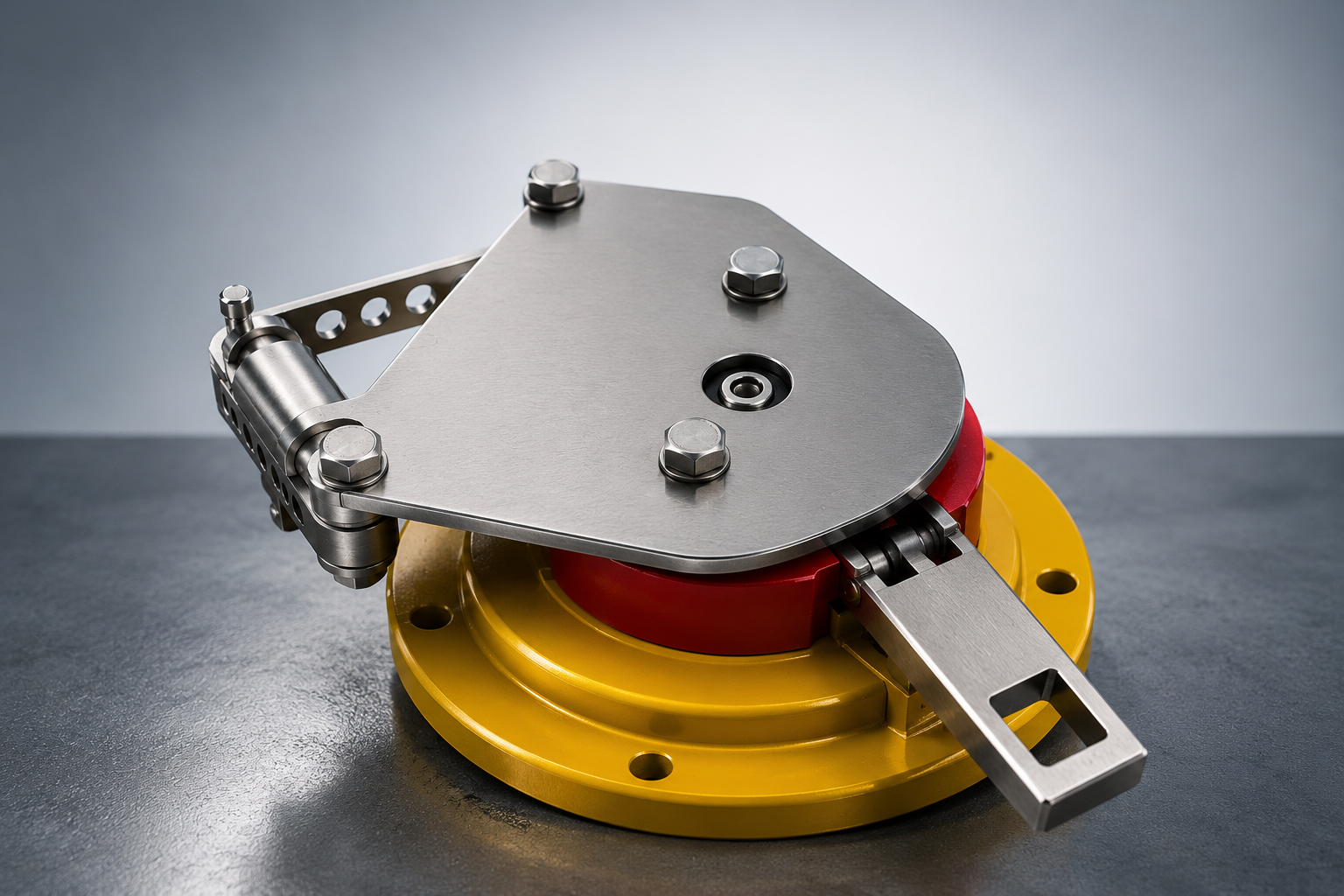
For this type of situation, there is a very straightforward mechanical solution: a safety lever with spring return. In many industrial environments, it is also called a dead man lever. The terminology may vary, but the function is clear: if the operator stops acting on the lever, the valve automatically returns to a safe position.
The point is not the handle. It is what the handle prevents.
A conventional manual valve stays in the position where it is left.
If an operator opens a ball valve to purge a line and then releases the handle, the valve will remain open. If a butterfly valve is opened to partially empty a vessel and the operator is interrupted, the valve will stay in that position until someone closes it again.
A spring-return lever changes that logic.
The operator must maintain the manual action for as long as the valve needs to remain open. Once the lever is released, the spring brings the mechanism back to its original position, usually closed.
That small change can make a major difference in day-to-day operation.
Where does a dead man lever make sense?
This accessory makes sense when the operation should remain manual, but the valve should not stay open without supervision.
We are not necessarily talking about large automation systems, control cabinets or complex instrumentation. We are talking about everyday operating points where a small lapse can create an incident.
| Typical operation | Why spring return helps | Common valve types |
|---|---|---|
| Sampling | Reduces the risk of product continuing to flow after the sample is taken | Ball valves, small quarter-turn valves |
| Line purging | Helps avoid an unattended purge point staying open | Ball valves, butterfly valves |
| Draining | Supports controlled discharge and operator presence during the manoeuvre | Ball valves, plug valves |
| Tank emptying | Prevents an open valve from continuing to drain after interruption | Butterfly valves, ball valves |
| Filling operations | Limits the chance of overfilling caused by an unattended manual valve | Ball valves, butterfly valves |
So if someone is looking for a manual valve that closes automatically, a valve that cannot be left open or a safety handle for a ball valve, they may be describing this same need.
How spring return works
The principle is simple.
The lever incorporates a spring mechanism that acts on the rotation of the valve. In ball and butterfly valves, the movement is usually a quarter turn, so the typical travel is 90 degrees.
- The operator moves the lever to open the valve.
- The valve remains open while the operator maintains the force on the handle.
- When the operator releases the lever, the spring returns the valve to its original safe position.
This keeps the operation manual while adding a mechanical barrier against forgetting, distraction or interruption. The idea is not to replace the operator. The idea is to help a simple action stay safe even when plant priorities change unexpectedly.
Why it is not just a handle with a spring
At first sight, it may look like a minor accessory: a lever, a spring, a housing and a coupling to the valve stem.
Operationally, it can be much more valuable than that.
A dead man lever does not automate the valve. It does not make it intelligent, and it does not replace a control system. Its function is more specific, which is exactly why it is useful: it helps prevent a manual valve from remaining open when the operator is no longer acting on it.
When a spring-return lever may be enoughUse it when the operator should stay physically present and the safest condition after release is for the valve to return closed.
When you may need more than a leverIf the process needs remote operation, position feedback, interlocks or control-room visibility, review an actuator, limit switch box or a more complete valve automation package.
It is not always necessary to install an actuator. It is not always necessary to add remote indication. It is not always necessary to integrate the valve into a control system.
Sometimes the first question is simply:
What should this valve do when the operator releases the handle?
If the answer is “return to closed”, a spring-return safety lever may be a very reasonable solution.
What should an engineer check before specifying one?
Even though the solution is simple, it should not be selected only by valve size.
The critical point is that the spring mechanism must be suitable for the real operating torque of the valve. That torque depends on several factors: size, pressure, seat design, valve construction, service conditions, frequency of operation and the mechanical condition of the assembly.
| Check | Why it matters |
|---|---|
| Valve type | Ball, butterfly, plug and other valve designs have different torque behaviour |
| Size and pressure rating | They influence the required return force and mounting configuration |
| Required operating torque | The spring must be capable of returning the valve reliably |
| Top connection | Compatibility with ISO 5211 or other mounting interfaces avoids adaptation issues |
| Stem or square dimensions | The coupling must match the valve stem geometry |
| Return direction | The mechanism must return the valve toward the correct safe position |
| Installation environment | Corrosion, outdoor exposure and washdown conditions can affect material choice |
| Area classification | ATEX or special execution requirements must be reviewed when applicable |
This matters because spring-return levers are available with different mounting connections and output torque ranges. Selection should therefore be technical, not just nominal.
When a dead man lever is not enough
A spring-return safety lever is useful when the operation remains manual and the goal is to prevent the valve from being left open by mistake.
But it is not always the complete solution.
| If the application needs… | Review… |
|---|---|
| Remote open/closed indication | Limit switch box or position monitoring |
| Remote operation | Pneumatic, electric or hydraulic actuator |
| Fail-safe closure after loss of utility | Spring-return actuator |
| Controlled access or procedural lockout | Mechanical lock or interlock system |
| Integration into a safety sequence | Control logic, interlocks and a validated automation concept |
The key is not to choose the most complex solution by default. The key is to choose the right level of protection for the real risk.
A quick way to think about it
Before requesting a solution, five questions can help frame the specification:
| Question | Why it matters |
|---|---|
| What happens if the valve is left open? | Defines the real operational risk |
| Does the manoeuvre need to remain manual? | Clarifies whether a lever is enough or remote operation is required |
| What is the safe position? | Usually closed, but it must be confirmed |
| Does the valve have a compatible top connection? | Avoids mounting and coupling issues |
| Is the return torque sufficient? | Prevents selecting a spring that cannot close the valve reliably |
These questions do not replace a technical review, but they help avoid a common mistake: asking for “a handle with a spring” when the real requirement is an operational safety function.
Conclusion
A manual valve can be simple, robust and perfectly suitable for the application. But if there is a risk that it may remain open when it should not, it is worth adding a barrier.
A dead man lever, or more descriptively a spring-return safety lever, solves exactly that problem: it allows the valve to return to a safe position when the operator stops acting on it.
It is especially relevant for ball valves, butterfly valves, purges, drains, sampling points and filling or emptying operations.
Not every valve needs to be automated. But every manual valve should be reviewed against one practical question:
What should happen when the operator releases the lever?