Emergency pressure relief in large industrial systems is not simply a matter of selecting a larger safety valve. Flare headers, flare gas recovery systems, gas transmission pipelines and petrochemical installations can combine significant relieving capacities, large pipe diameters and demanding operating conditions.
Conventional pressure safety valves and rupture discs remain established solutions. However, selected applications may justify evaluating alternative technologies, including shear pin pressure relief devices and buckling pin relief valves. The objective is not to replace conventional pressure protection, but to select the most appropriate operating principle for the complete relief scenario.
What is a shear pin pressure relief device?
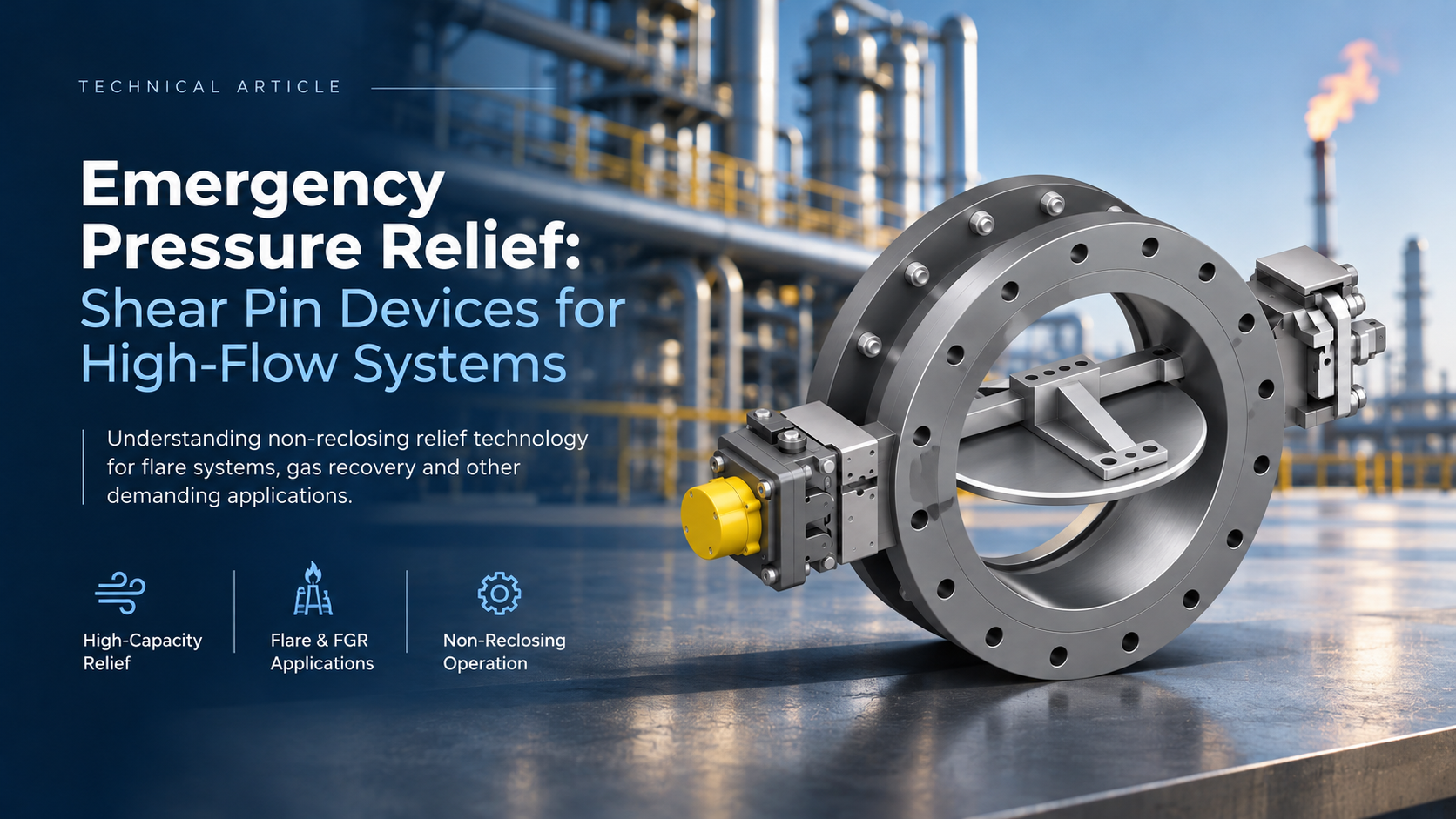
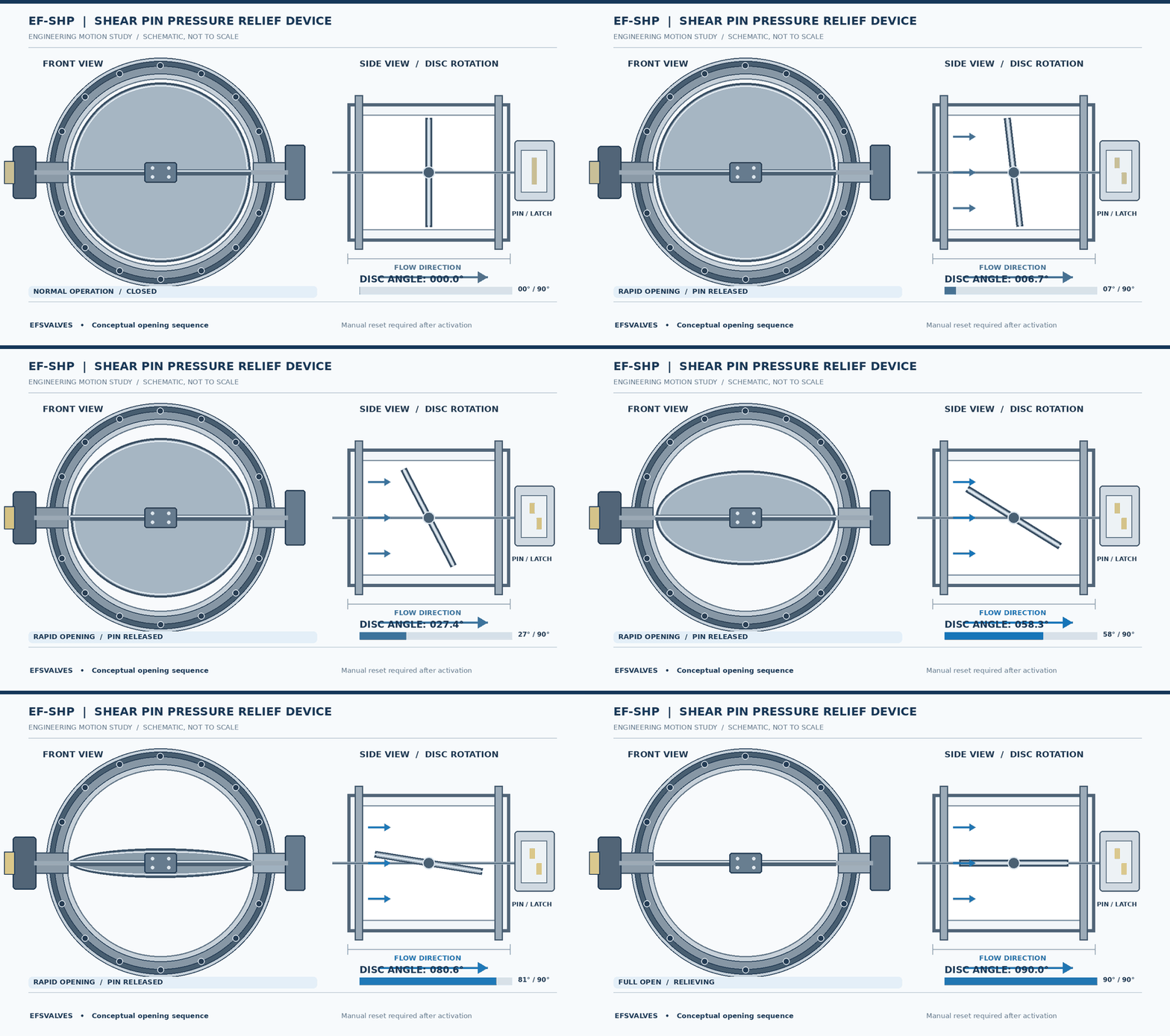
A shear pin pressure relief device is a mechanically actuated, non-reclosing device designed to protect pressurised systems against a defined overpressure event. During normal operation, a calibrated mechanical element retains the closure mechanism in its closed position.
When the applicable differential pressure reaches the specified activation pressure, the pin shears, releases the mechanism and allows the device to open. In an inline butterfly-style configuration such as the EFSVALVES EF-SHP, the rotating disc opens to provide a large discharge flow path.
Unlike a conventional spring-loaded safety valve, a non-reclosing shear pin device does not automatically return to its closed position after pressure decreases. Following activation, the device must be isolated, inspected and reset with the correct calibrated replacement pin in accordance with the applicable operating procedure.
What makes high-flow emergency pressure relief different?
High-flow emergency relief applications must be evaluated as complete pressure protection systems. The following parameters influence device selection:
- Required relieving capacity: the device must accommodate the calculated emergency flow under the applicable relieving conditions.
- Operating and activation pressures: the relationship between normal operating pressure, backpressure and the required activation pressure must be compatible with the selected technology.
- Opening characteristics: activation behaviour and effective discharge area influence system response.
- Backpressure: downstream pressure conditions must be considered when evaluating both the device and the discharge system.
- System availability: the consequences of activation, shutdown, isolation and resetting must be incorporated into the operating philosophy.
- Applicable codes: the selected configuration must satisfy the relevant pressure protection, testing and certification requirements.
Why consider shear pin technology for high-capacity relief?
Shear pin technology introduces an alternative mechanical activation principle to conventional spring-loaded pressure safety valves. Depending on the selected configuration, potential engineering advantages include the following.
Large discharge flow path
Inline butterfly-style devices can provide a substantial flow passage following activation. This makes them relevant for selected high-capacity pressure relief and emergency discharge applications. Effective relieving capacity must nevertheless be established from validated performance data, including the applicable flow characteristics and discharge coefficients.
Mechanically defined activation
A calibrated shear pin forms part of the activation mechanism. The required activation pressure, allowable operating pressure and activation tolerance depend on the device design, service conditions and qualification basis.
Non-reclosing emergency relief
Once activated, the device remains open until it is inspected and reset. This characteristic may suit emergency shutdown arrangements where continued process operation is not required following the relief event. The consequences of sustained discharge must always be assessed.
Alternative installation configurations
Depending on the equipment design, an inline relief device may offer a different piping arrangement from a conventional angle-pattern safety valve. Installation advantages must be evaluated together with space, accessibility, discharge routing, isolation and maintenance procedures.
Flare headers and gas recovery systems
Flare headers, flare gas recovery systems and large-diameter gas piping can present demanding emergency pressure relief requirements. Engineers must consider the interaction between operating pressure, emergency activation pressure, required relieving capacity, backpressure and the complete discharge-system configuration.
A shear pin pressure relief device may be considered for selected applications involving:
- Flare header pressure relief: emergency overpressure protection in flare-related piping systems.
- Flare gas recovery: selected bypass or emergency relief arrangements where the operating philosophy permits non-reclosing activation.
- Gas transmission pipelines: large-diameter systems requiring evaluation of high-flow overpressure protection.
- Petrochemical processing: installations involving significant gas flows and project-specific emergency relief requirements.
- Industrial emergency venting: selected duties where rapid opening and a large discharge path are relevant.
Suitability must be verified for each installation. A large pipe diameter or high calculated flow does not automatically justify selecting a shear pin device.
Shear pin vs buckling pin vs rupture disc
Shear pin devices, buckling pin relief valves and rupture discs can all form part of non-reclosing pressure relief arrangements, but their operating principles differ.
| Technology | Operating principle | Behaviour after activation |
|---|---|---|
| Spring-loaded PSV | Pressure force overcomes spring loading | Normally recloses automatically |
| Shear pin device | A calibrated mechanical element shears and releases the closure | Non-reclosing; requires inspection and resetting |
| Buckling pin valve | A calibrated compression element buckles and initiates opening | Typically non-reclosing; design-dependent |
| Rupture disc | A pressure-sensitive disc opens at specified burst conditions | Non-reclosing; requires replacement |
A shear pin pressure relief device activates through mechanical shearing. A buckling pin relief valve, sometimes associated with the broader term rupture pin valve, operates through buckling of a calibrated compression element. A rupture disc uses a pressure-sensitive element designed to open at specified differential-pressure and temperature conditions.
These technologies are not interchangeable without engineering verification. Selection depends on relieving capacity, activation characteristics, operating pressure, leakage requirements, backpressure, maintenance strategy and applicable codes.
When should engineers consider a large-diameter relief device?
Large-diameter pressure relief applications often involve significant flow requirements and complex discharge arrangements. The correct solution cannot be determined from nominal pipe diameter alone. Engineers should establish:
- The credible overpressure scenario and required relieving capacity.
- The normal operating pressure and required activation pressure.
- The process fluid, operating temperature and relieving conditions.
- The expected backpressure and discharge-system configuration.
- Whether non-reclosing operation is acceptable within the plant safety philosophy.
- The available validated or certified performance data.
- The applicable design codes, inspection and documentation requirements.
These parameters determine whether a conventional PSV, large-capacity safety valve, rupture disc or pin-actuated relief device is suitable.
EF-SHP for high-capacity emergency pressure relief
The EFSVALVES EF-SHP Shear Pin Pressure Relief Device extends the EFSVALVES pressure protection portfolio with a mechanically actuated, non-reclosing relief solution. Its inline butterfly-style arrangement is intended for applications where a large discharge flow path and defined mechanical activation are relevant design considerations.
The EF-SHP complements conventional pressure safety valves, large-capacity safety valves and rupture discs by adding a different operating principle for selected industrial duties. This broader portfolio allows each relief scenario to be evaluated against its process conditions, project specifications and applicable requirements.
Frequently asked questions
What is an emergency pressure relief device?
An emergency pressure relief device protects a pressurised system by providing a discharge path during a defined overpressure event. Depending on the application, protection may be provided by conventional safety valves, rupture discs or specialised non-reclosing devices.
What is the difference between a shear pin and a buckling pin valve?
A shear pin device activates when a calibrated mechanical element shears. A buckling pin device activates when a calibrated compression element buckles. Both mechanisms can be used in non-reclosing relief systems, but their design and qualification requirements differ.
Can a shear pin device replace a conventional PSV?
It may be evaluated as an alternative in selected applications. Suitability depends on the required relieving capacity, operating conditions, applicable codes and whether non-reclosing operation is acceptable within the plant safety philosophy.
Are shear pin devices suitable for flare headers?
They may be considered for selected flare header, flare bypass and gas recovery arrangements. Suitability depends on the complete pressure protection system, including backpressure, activation conditions, discharge capacity and the consequences of sustained opening.
Is a shear pin device the same as a rupture disc?
No. Both may provide non-reclosing pressure relief, but their activation mechanisms differ. A shear pin device uses a calibrated mechanical release element, while a rupture disc opens through a pressure-sensitive bursting element.
What is a rupture pin valve?
The term rupture pin valve is sometimes used for pressure relief devices activated by a calibrated pin element, particularly buckling pin designs. Because terminology varies, the actual operating mechanism should always be verified.
Can shear pin devices be used for high-capacity relief?
They may suit selected high-capacity applications. Nominal diameter and a large flow passage do not by themselves establish certified relieving capacity; device-specific performance data and the applicable code requirements must be reviewed.
Engineering takeaway
Emergency pressure relief is a system engineering decision, not simply a valve sizing exercise.
Shear pin technology offers an additional operating principle for selected high-flow and emergency pressure relief applications. Its value depends on understanding the complete protection scenario, required relieving capacity, opening mechanism and consequences of non-reclosing operation.
Need support with a high-flow or emergency pressure relief application? Contact EFSVALVES to discuss the process conditions, relieving requirements and potential pressure protection solutions.